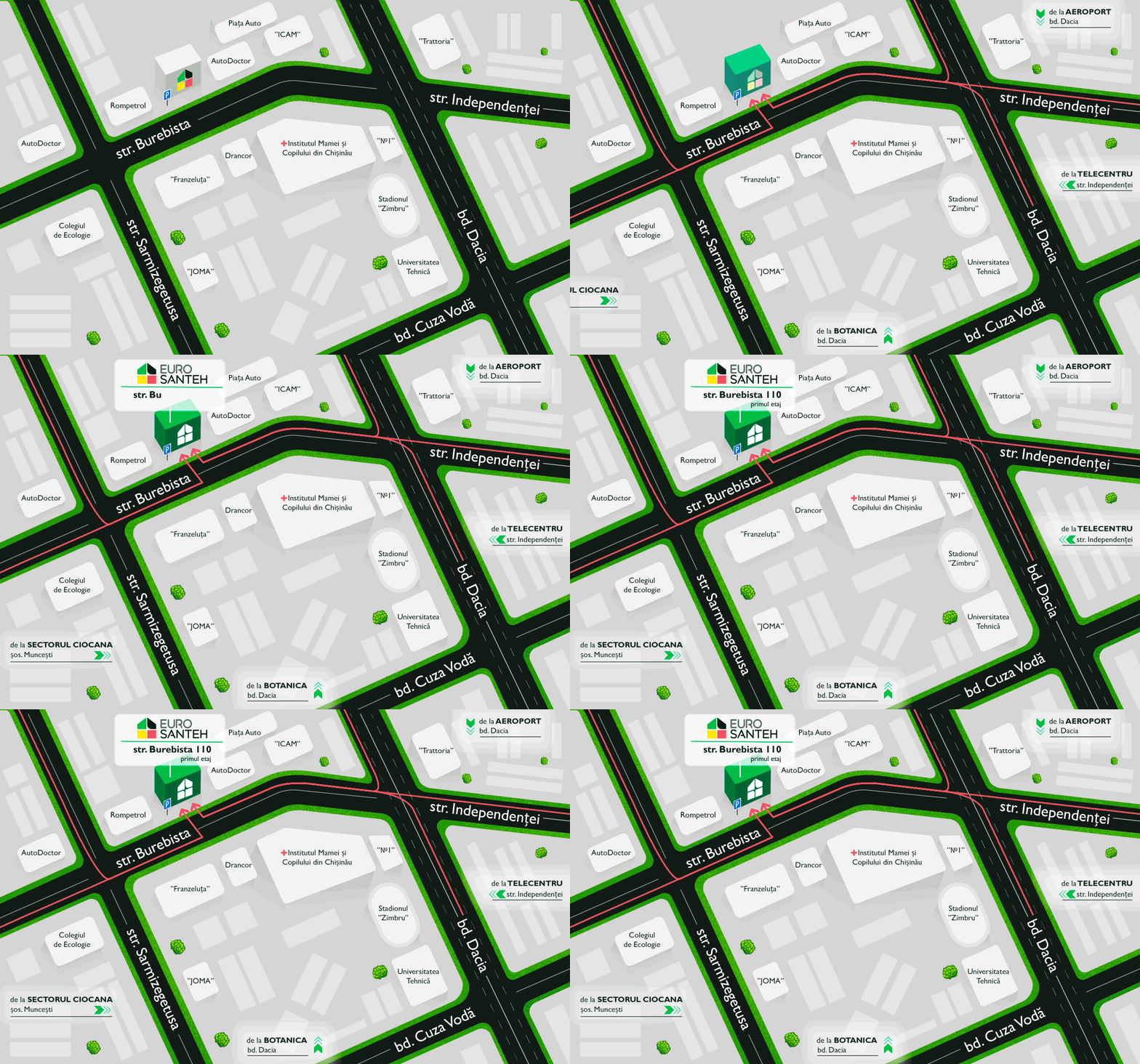
Chisinau, str. Burebista 110




 Call
Call 

 Product has been added to favorites

Professional Floor-Ceiling Air Conditioner Installation for Businesses in Moldova


 Reviews


What Is a Floor-Ceiling Air Conditioning System and What Are Its Key Features?
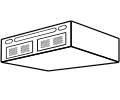
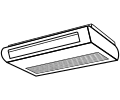
A floor-ceiling air conditioner is the solution for spaces where a standard split system is no longer effective
It is a semi-commercial split system with a capacity of 5 to 16 kW, designed for spaces of 50–200 m² and operation 8–12 hours per day.
Unlike residential models rated at 2.5–3.5 kW, it does not operate “at its limit.” The compressor and heat exchanger are engineered for large air volumes and constant heat gain.
In short: it’s not just a “more powerful air conditioner,” but a different class of equipment.
Even cooling at distances up to 12 meters
The main challenge in large spaces is not just capacity, but air distribution.
A wall-mounted unit cools the area directly in front of it. At a distance of 6–8 meters, the temperature may differ by 3–5°C.
A floor-ceiling system creates a directed airflow along the room. Air travels the entire length of the space, stabilizing temperature without cold “spots” or overheated zones.
This is especially critical for:
open-plan retail stores
open-space offices
restaurants with constant foot traffic
The result is stable temperature across the entire area, not just near the unit.
Flexible installation without a suspended ceiling
Cassette systems require 25–30 cm of ceiling space. If unavailable, installation becomes expensive or impossible.
A floor-ceiling unit can be installed:
horizontally under the ceiling
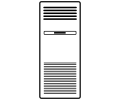
or vertically along a wall
This reduces installation costs and makes the system suitable for finished interiors without ceiling reconstruction.
Designed for commercial load, not residential use
Residential models are designed for apartments of 20–40 m² and irregular operation.
In commercial spaces, heat gain comes from:
lighting
equipment
display windows
10–30 people simultaneously
Each person adds approximately 100 W of heat load. In an office with 20 employees, that’s already an additional +2 kW to the calculation.
A floor-ceiling system accounts for these parameters and operates reliably without compressor overheating.
Who Is a Floor-Ceiling Air Conditioner Suitable For?


What Is Included in Standard Floor-Ceiling Air Conditioner Installation?
Floor-ceiling air conditioners rated at 5–16 kW operate under high load. An installation error can reduce compressor lifespan by half. That is why standard installation is not just “mount and switch on,” but a structured engineering process.
1. Engineering calculation before installation
Before work begins, the following are calculated:
- room area and ceiling height
- heat gains (lighting, equipment, people — ~100 W per person)
- allowable refrigerant line length
- required system capacity
Without proper calculation, the system will either undercool the space or operate at maximum load and consume excess electricity.
2. Proper mounting of the indoor unit
The unit is installed:
- under the ceiling with airflow directed along the room
or - vertically along a wall
Clearances from the ceiling, walls, and furniture are considered. Incorrect positioning can cause drafts and temperature differences of 3–5°C across the room.
3. Refrigerant line installation (up to 3 meters included in standard)
Standard installation includes:
- proper-diameter copper pipes
- thermal insulation
- drainage line
- power cable
- decorative trunking
Using thin-walled pipes or poor-quality insulation leads to refrigerant leaks and reduced performance within 1–2 seasons.
4. System vacuuming (mandatory stage)
Air and moisture are removed from the refrigerant line using a vacuum pump until the required vacuum level is reached.
Skipping this step is the main cause of compressor failure. Moisture inside the system forms acid that damages internal components.
5. Leak and pressure testing
Before startup, the following are performed:
- connection inspection
- operating pressure control
- cooling and heating mode testing
A properly installed system should ensure a temperature difference of 8–12°C between return and supply air.
6. Commissioning and warranty handover
After testing, the client receives:
- completion report
- installation warranty
- maintenance recommendations
Regular servicing 1–2 times per year allows the system to operate reliably for 10 years or more.
Cost of Floor-Ceiling Air Conditioner Installation in Chișinău
How Floor-Ceiling Air Conditioner Installation Is Performed
Why Is It Important to Trust Installation to Professionals?
Installation errors can cut the system’s lifespan in half
The compressor is the most expensive component of an air conditioner, and replacing it can cost up to 30–40% of a new system’s price. Incorrect refrigerant line length, skipping vacuuming, or bending copper pipes can lead to overheating and refrigerant leaks within just 1–2 seasons. Professional installation minimizes these risks.
Improper installation increases electricity consumption
If the system is selected or connected without calculating the heat load, it will operate at maximum capacity most of the time. This increases energy consumption by 15–25% and accelerates equipment wear. An engineering-based approach ensures the system operates in optimal mode without overload.
Loss of manufacturer warranty
Most manufacturers require strict compliance with installation procedures: vacuuming, pressure control, and correct electrical connection. Failure to meet these requirements automatically voids the official warranty. With professional installation, all parameters are verified and documented according to brand standards.
Installation accounts for 30–40% of the system’s reliability
Even high-quality equipment cannot compensate for installation mistakes. Professional installation ensures airtight connections, stable operation, and even cooling distribution. It is an investment in 8–12 years of reliable performance, not just 2–3 seasons of operation.
Frequently asked questions


Standard installation for systems up to 7 kW starts from 3,500–5,500 MDL.
The final cost depends on refrigerant line length and the complexity of mounting the outdoor unit. The estimate is fixed before work begins — with no additional charges after installation.
Yes, if the room area is 50 m² or larger, or ceiling height exceeds 3 meters.
In a 30–35 m² room, such a system would be oversized and lead to higher electricity consumption.
Wall-mounted models are designed for 20–40 m² and provide localized cooling.
A floor-ceiling system distributes airflow up to 8–12 meters and stabilizes temperature across 70–150 m² without “cold zones.”
In 80% of cases, installation takes one working day.
If the refrigerant line exceeds 5–7 meters or height work is required — up to 2 days.
For systems above 7 kW, a dedicated electrical line with circuit protection is recommended.
Connecting to an old network without proper calculation may cause cable overheating and emergency shutdowns.
Manufacturers require compliance with installation standards: correct piping, vacuuming, and pressure control.
If these steps are not followed, the official warranty becomes void.
Our installers





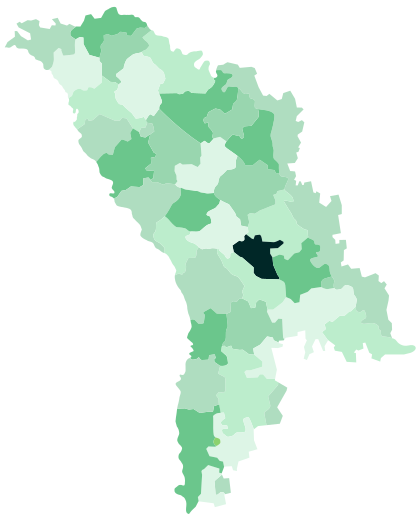
We provide air conditioner installation services throughout Moldova
- Anenii Noi
- Balti
- Basarabeasca
- Bender
- Biruinta
- Briceni
- Bucovat
- Cahul
- Cainari
- Calarasi
- Camenca
- Cantemir
- Causeni
- Ceadir Lunga
- Chisinau
- Cimislia
- Codru
- Comrat
- Cornesti
- Costesti
- Crasnoe
- Cricova
- Criuleni
- Cupcini
- Dnestrovsc
- Donduseni
- Drochia
- Dubasari
- Durlesti
- Edinet
- Falesti
- Floresti
- Frunza
- Ghindesti
- Glodeni
- Grigoriopol
- Hincesti
- Ialoveni
- Iargara
- Leova
- Lipcani
- Maiac
- Marculesti
- Nisporeni
- Ocnita
- Orhei
- Otaci
- Rezina
- Ribnita
- Riscani
- Singera
- Singerei
- Slobozia
- Soldanesti
- Soroca
- Stefan Voda
- Straseni
- Taraclia
- Telenesti
- Tiraspol
- Tvardita
- Ungheni
- Vadul lui Voda
- Vatra
- Vulcanesti


 Product catalog