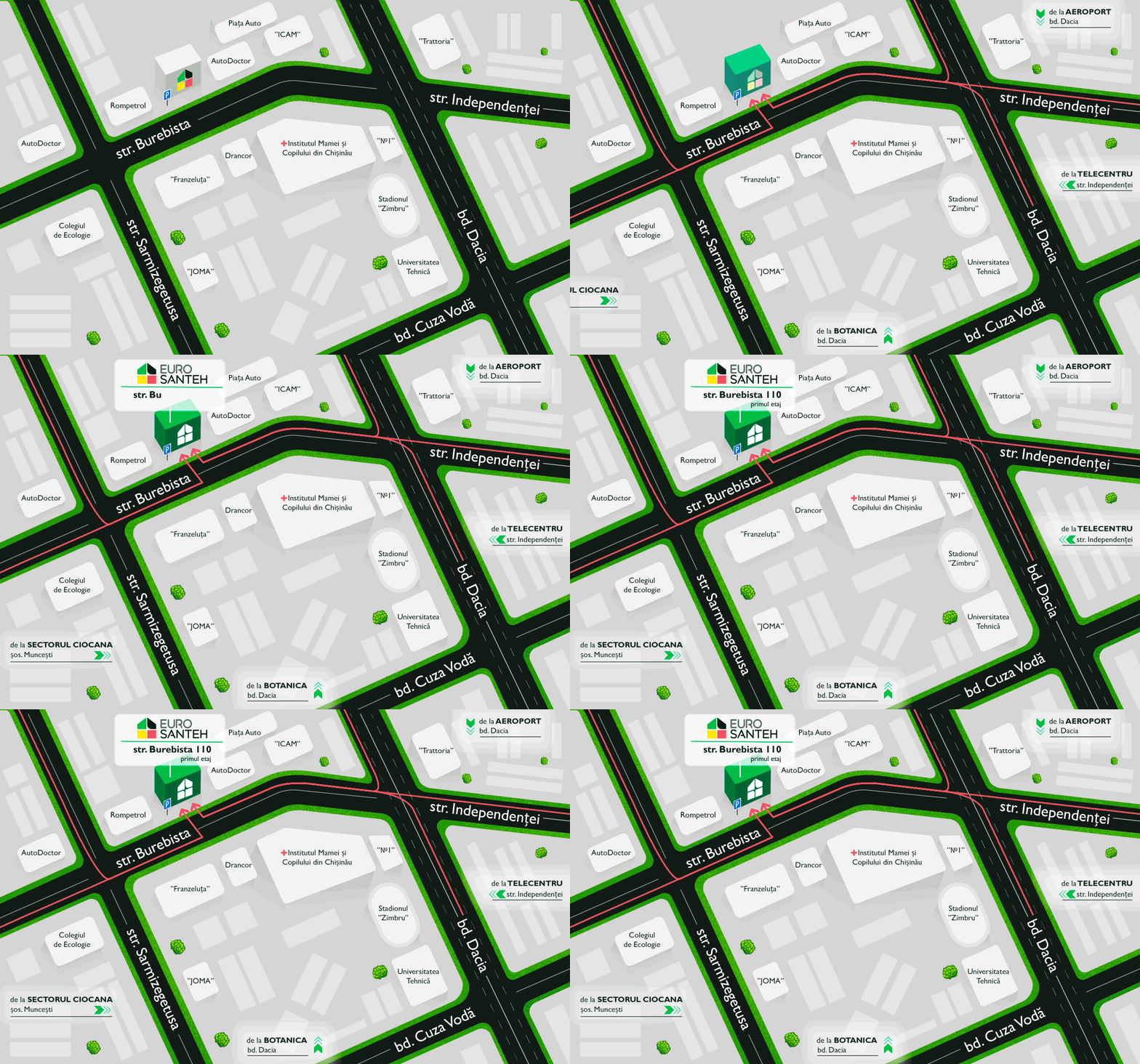
Chisinau, str. Burebista 110




 Call
Call 

 Product has been added to favorites

Column Air Conditioner Installation for Businesses in Chișinău — No Mistakes, Rework, or Financial Loss


 Reviews


What Is a Column Air Conditioner and What Are Its Features?
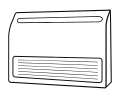
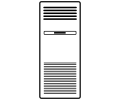
A column air conditioner is a powerful floor-standing split system (24,000–48,000 BTU) designed to cool commercial spaces from 70 to 500+ m² without ceiling installation. It creates a directed airflow of up to 15–20 meters and can quickly stabilize temperature even under high heat load.
It is a solution for businesses where wall-mounted air conditioners simply cannot cope.
Why standard systems don’t work in large halls
A 12,000–18,000 BTU wall-mounted unit is designed for a maximum of 30–40 m².
In a 120 m² restaurant with large glass fronts, a kitchen, and 40 guests, the heat load increases by 2–3 times. The equipment starts operating at its limit, the compressor overheats, electricity consumption rises, and the room temperature remains unstable.
Saving on capacity almost always results in reinstalling a more powerful system later.
The key feature of a column system
A column air conditioner is designed based on air volume.
A 180 m² hall with a 3.5 m ceiling contains over 600 m³ of air. A 36,000 BTU system cools this volume 2–3 times faster than standard residential solutions due to higher airflow capacity and intensive circulation.
It doesn’t just “maintain coolness” — it actively processes the entire air volume.
The main advantage for businesses
A column system provides high capacity without reconstructing the premises.
Unlike cassette or duct systems, it does not require a suspended ceiling or complex design. The unit is installed on the floor, installation takes less time, and the facility can be launched faster.
This reduces construction costs and minimizes business downtime.
Who Is a Column Air Conditioner Suitable For?

What Is Included in Standard Column Air Conditioner Installation?
Standard installation of a floor-standing (column-type) air conditioner is a комплекс of engineering works that directly affects equipment lifespan, cooling stability, and the absence of unexpected expenses.
If even one stage is performed superficially, the system may start losing performance in the very first season.
1. Engineering inspection and heat load calculation
Installation does not begin with drilling, but with calculation.
Floor area, ceiling height, glazing, number of occupants, equipment, and sun exposure are all taken into account.
Why is this critical?
Insufficient capacity = constant compressor overload.
Excessive capacity = unnecessary energy consumption and temperature fluctuations.
A column-type air conditioner is selected based on heat load in kW, not simply “by square meters.”
2. Line design and unit positioning
The indoor unit location is determined considering airflow and occupied zones.
The refrigerant line length is calculated (typically 3–5 meters included in standard installation), along with drainage and interconnecting cable routing.
Errors at this stage may lead to:
– drafts
– “dead zones” without cooling
– leaks
– system overheating
Capacity without proper geometry is useless.
3. Installation of indoor and outdoor units
The indoor unit is fixed on a level base, taking vibration into account.
The outdoor unit is mounted on reinforced brackets or a dedicated base calculated for weight and vibration load.
Weak mounting increases noise, accelerates compressor wear, and may lead to emergency situations.
For commercial equipment, this is unacceptable.
4. Mandatory system vacuuming
This is the key stage that distinguishes professional installation from “cheap” work.
Air and moisture are removed from the circuit using a vacuum pump.
If skipped, condensation forms inside the system, which:
– damages compressor oil
– reduces cooling capacity
– shortens equipment lifespan
Most warranty rejections are related to skipped vacuuming.
5. Electrical connection with protection
Column-type units rated at 36,000–48,000 BTU often require a dedicated power line and circuit breaker.
Connecting to an overloaded existing network may cause:
– voltage fluctuations
– emergency shutdowns
– control board failure
Commercial equipment must operate reliably, especially during peak season.
6. Commissioning and parameter verification
Refrigerant pressure, temperature difference between air intake and outlet, automation systems, and drainage are checked.
Only after these checks is the project considered completed.
Starting the system “without testing” is not installation — it is an experiment at the client’s expense.
How much does column air conditioner installation cost in Chișinău?
| Current installation prices | |
|---|---|
| Standard installation of a column -type air conditioner | 6 200 MDL |
How column air conditioner installation is performed
Why is it important to trust installation to professionals?
Incorrect capacity calculation = constant system overload
Installation “without calculation” forces the equipment to operate at its limit. The compressor cannot reach normal operating mode, indoor temperature becomes unstable, and energy consumption increases. After 1–2 seasons, the system loses performance, and the business faces customer complaints and additional expenses.
Saving money on proper capacity selection almost always ends with equipment replacement.
Skipping vacuuming damages the compressor from the inside
Unqualified installers often skip vacuuming to reduce installation time. As a result, moisture and air remain inside the system, damaging compressor oil and reducing cooling capacity. The failure may appear months later — often after the “warranty” has expired.
This is one of the most common causes of expensive repairs.
Electrical connection errors create accident risks
36,000–48,000 BTU systems require a dedicated power line and proper protection. Connecting to an overloaded existing network leads to voltage fluctuations, control board overheating, and shutdowns during peak season. For a restaurant or retail space, this means downtime, dissatisfied customers, and revenue loss.
Commercial equipment should not be connected like household appliances.
Weak mounting and incorrect piping = costly rework
Improper drainage slope causes leaks. Weak brackets increase vibration and noise. Incorrectly calculated piping length reduces cooling efficiency. These issues usually appear after project completion, when fixing them costs more than proper installation from the start.
Rework costs 1.5–2 times more than doing it correctly the first time.
Frequently asked questions


The average cost of standard installation in Chișinău starts from 6200 lei, depending on capacity (24,000–48,000 BTU) and piping length. The exact price is determined after site inspection and heat load calculation.
Standard installation takes 1 working day for piping up to 3–5 meters. More complex projects involving height work or an additional power line may require 1–2 days.
Yes, installation is possible during the cold season. Outdoor temperature only affects testing mode, not the installation and vacuuming process itself.
For 36,000–48,000 BTU models, most commercial properties require a dedicated power line with circuit protection. Connecting to an overloaded existing network increases the risk of emergency shutdowns.
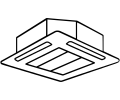
A column system does not require a suspended ceiling and is installed faster. A cassette system distributes air more evenly but requires technical design and higher installation costs.
Modelele de 24 000 BTU sunt potrivite pentru spații de 60–90 m², 36 000 BTU pentru 120–200 m², iar 48 000 BTU pentru până la 400–500 m² la o înălțime standard a tavanului.
Yes. Installation can be organized without stopping business operations if equipment placement and electrical connection are planned in advance.
Our installers





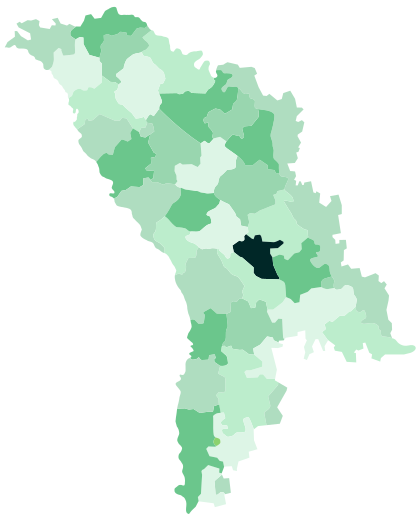
We provide air conditioner installation services throughout Moldova
- Anenii Noi
- Balti
- Basarabeasca
- Bender
- Biruinta
- Briceni
- Bucovat
- Cahul
- Cainari
- Calarasi
- Camenca
- Cantemir
- Causeni
- Ceadir Lunga
- Chisinau
- Cimislia
- Codru
- Comrat
- Cornesti
- Costesti
- Crasnoe
- Cricova
- Criuleni
- Cupcini
- Dnestrovsc
- Donduseni
- Drochia
- Dubasari
- Durlesti
- Edinet
- Falesti
- Floresti
- Frunza
- Ghindesti
- Glodeni
- Grigoriopol
- Hincesti
- Ialoveni
- Iargara
- Leova
- Lipcani
- Maiac
- Marculesti
- Nisporeni
- Ocnita
- Orhei
- Otaci
- Rezina
- Ribnita
- Riscani
- Singera
- Singerei
- Slobozia
- Soldanesti
- Soroca
- Stefan Voda
- Straseni
- Taraclia
- Telenesti
- Tiraspol
- Tvardita
- Ungheni
- Vadul lui Voda
- Vatra
- Vulcanesti


 Product catalog