Chisinau, str. Burebista 110



 Phone call

 Product has been added to favorites

Multi-Split System: How to Choose AC for 2–5 Rooms in an Apartment or House

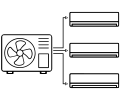
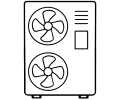
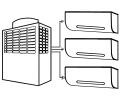
A multi-split system uses one outdoor unit connected to several indoor units. It is a practical solution when you want to keep the façade clean or have limited space for outdoor units, but choosing the right setup requires attention to detail.
Multi-split systems are commonly selected for apartments and houses where several rooms need air conditioning, without installing multiple outdoor units. This approach helps maintain a tidy exterior and simplifies installation on balconies or restricted areas.
How a multi-split system works — simple explanation
In a multi-split system, the outdoor unit distributes capacity between multiple indoor units. When only one room is operating, the system runs efficiently. When several rooms are active, the outdoor unit increases output and shares it between zones.
It is important to note that residential multi-split systems usually operate in a single mode: cooling or heating. Different modes cannot be used simultaneously in different rooms.
When a multi-split makes more sense than multiple split units
A multi-split system is often considered for homes with 2–5 rooms when façade restrictions apply or outdoor unit space is limited. It is also chosen when a unified installation and maintenance approach is preferred.
Advantages and limitations — a balanced view
When a multi-split is a good choice:
- Façade restrictions or preference for a single outdoor unit.
- Air conditioning for 2–5 rooms with independent room control.
- Cleaner exterior appearance with fewer outdoor units.
What should be considered in advance:
- More complex installation due to longer piping routes.
- One outdoor unit serves all indoor units.
- Single operating mode for the entire system.
Key points when choosing a configuration
1) Number of rooms and indoor unit types. Bedrooms usually require low noise, while living rooms need higher capacity.
2) Total capacity and simultaneous use. If several rooms operate at the same time, the system must be sized accordingly.
3) Piping routes and lengths. Early planning helps achieve a cleaner and more reliable installation.
4) Outdoor unit placement. Proper airflow and service access are essential.
Practical example: 3-room apartment
A common scenario is an apartment with a living room and two bedrooms. Typically, a higher-capacity unit is selected for the living room, while quieter units are chosen for bedrooms. The outdoor unit is selected based on real usage patterns rather than theoretical maximum load.
Installation: common mistakes
Most issues result from poorly planned piping routes, incorrect drainage slope, or limited access for maintenance. In a multi-split system, these details affect all connected rooms.
Models and pricing
Available options and suitable configurations can be found in the category: wall-mounted multi-split systems.
Questions and answers
Is a multi-split better than multiple separate split systems?
Not always. It works best under specific conditions and requires careful planning.
Can all rooms operate at the same time?
Yes, if the system is properly sized.
What matters more: capacity or piping?
Both are essential for comfort and long-term reliability.
Is it suitable for a small balcony?
Often yes, but installation conditions should be evaluated.
Where can I see available models?
In the category: wall-mounted multi-split systems.


 Product catalog