We sell, deliver and install climate control equipment throughout the Republic of Moldova

Inverter Cassette Air Conditioners: The Expert Choice for Business and Large Spaces

The ideal concealed climate control solution for offices, shops, and restaurants with suspended ceilings. Inverter technology ensures quiet operation, uniform 360° airflow, and significant energy savings over large areas
Price
from
lei
up to
lei
Brand
Room area, m²
Power, BTU
Heating to, °C
Compressor
Sorting:
Power, BTU
12000
Heating to, °C
-20...+24
Compressor
Inverter
27 965 lei
Power, BTU
18000
Heating to, °C
-20...+24
Compressor
Inverter
29 240 lei
prod installation It is possible to order with installation
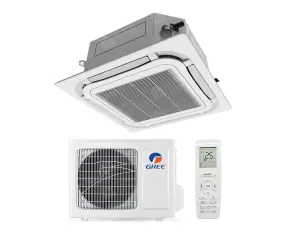
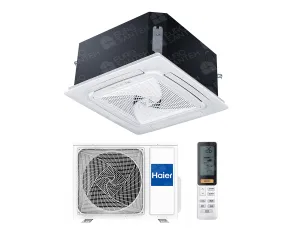
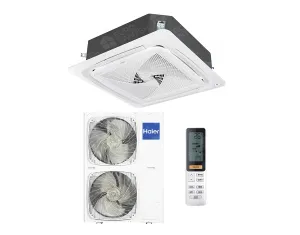
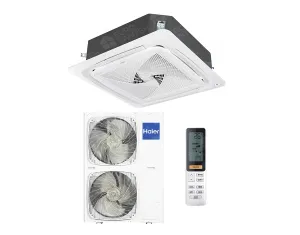
CASETA 4-way HAIER AB35S2SC2FA/1U35S2SM1FA + panel
Power, BTU
12000
Heating to, °C
-20...+24
Compressor
Inverter
24 323 lei
21 525 lei
prod installation It is possible to order with installation

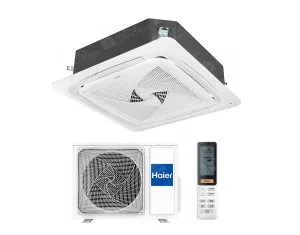
CASETA 4-way HAIER AB50S2SC2FA/1U50S2SJ2FA + panel
Power, BTU
18000
Heating to, °C
-20...+24
Compressor
Inverter
25 764 lei
22 800 lei
prod installation It is possible to order with installation
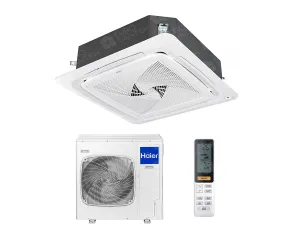
CASETA 4-way HAIER AB71S2SG1FA/1U71S2SR2FA + panel
Power, BTU
24000
Heating to, °C
-20...+24
Compressor
Inverter
31 697 lei
28 050 lei
prod installation It is possible to order with installation

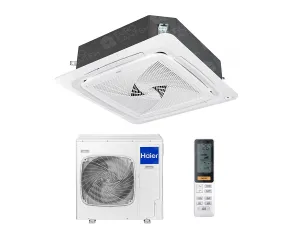
CASETA 4-way HAIER ABH105H1ERG/1U105S2SS2FA + panel
Power, BTU
36000
Heating to, °C
-20...+24
Compressor
Inverter
45 511 lei
40 275 lei
prod installation It is possible to order with installation

caseta round HAIER ABH125K1ERG/1U125S2SN2FB + panel
Power, BTU
42000
Heating to, °C
-20...+24
Compressor
Inverter
51 528 lei
45 600 lei
prod installation It is possible to order with installation
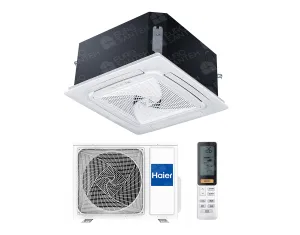
caseta round HAIER ABH140K1ERG/1U140S2SN1FB + panel
Power, BTU
48000
Heating to, °C
-20...+24
Compressor
Inverter
59 071 lei
52 275 lei
Power, BTU
24000
Heating to, °C
-20...+24
Compressor
Inverter
35 700 lei
Power, BTU
30000
Heating to, °C
-20...+24
Compressor
Inverter
41 650 lei
Power, BTU
36000
Heating to, °C
-20...+24
Compressor
Inverter
51 000 lei
Power, BTU
42000
Heating to, °C
-20...+24
Compressor
Inverter
57 800 lei
Power, BTU
48000
Heating to, °C
-20...+24
Compressor
Inverter
66 300 lei
caseta round HAIER ABH160K1ERG/1U160S2SP1FB + panel
Power, BTU
60000
Heating to, °C
-20...+24
Compressor
Inverter
63 393 lei
56 100 lei
Power, BTU
42000
Heating to, °C
-15...+24
Compressor
Inverter
55 325 lei
48 960 lei
Power, BTU
60000
Heating to, °C
-20...+24
Compressor
Inverter
71 400 lei
Shown from 1 by 16 from 44 results

Inverter Cassette Air Conditioners: An Expert Guide to Selection and Operation for Business and Home

Cassette air conditioners represent the gold standard in climate control for commercial and spacious residential premises. It is not merely a cooling device, but an integrated engineering system hidden behind a suspended ceiling, leaving only an elegant decorative panel visible. Combining high performance, unobtrusive design, and advanced inverter technology, these split systems ensure the ideal microclimate in offices, shops, restaurants, and conference halls. In this detailed guide, we will break down all aspects of choosing cassette air conditioners available at Eurosanteh, from leading global brands to the intricacies of installation.


What is a Cassette Air Conditioner and Why is it the Optimal Solution for Large Spaces?

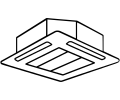
A cassette air conditioner is a type of semi-industrial split system designed specifically for rooms with suspended ceilings (such as "Armstrong" type, grid ceilings, or plasterboard constructions). Its key feature lies in the installation method of the indoor unit: it is embedded into the inter-ceiling space so that its lower part—the decorative grille with louvers— sits flush with the ceiling plane. This engineering solution solves two problems simultaneously: aesthetic (equipment does not clutter walls) and functional (air is supplied from top to bottom, ensuring uniform distribution).

Working Principle and Design Features of Ceiling Units

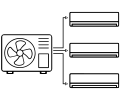
Like any split system, the cassette type consists of two main modules: an outdoor compressor-condenser unit and an indoor evaporator unit. They are connected by copper pipes for refrigerant (freon) circulation and electrical wiring.

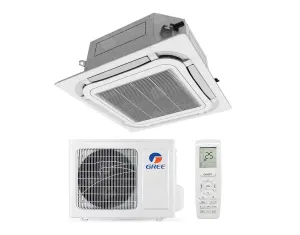
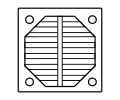
The uniqueness of the "cassette" indoor unit lies in its square (rarely rectangular) shape and air distribution system. Warm air intake from the room occurs through the center of the decorative panel, where a coarse filter is located. After cooling or heating in the heat exchanger, the air is blown back into the room through louvers located along the perimeter of the panel. Unlike wall-mounted models that create a directed flow, cassette units provide 4-way (and in modern models — circular 360°) air distribution. This allows avoiding overcooling zones and drafts, creating a uniform temperature background even in rooms with complex shapes and large areas.

An important structural element of all cassette units is the built-in drain pump (condensate pump). Since the unit is located in the ceiling, gravity drainage of condensate is often impossible. The pump forcibly lifts accumulated moisture to a certain height (usually up to 750–1000 mm), from where it then flows into the sewage system or outside.

Inverter Technology: The Key to Energy Efficiency and Comfort

All models of cassette air conditioners presented in this category (brands Haier, Gree, Midea, Mitsubishi Electric, etc.) are equipped with inverter compressors. Historically, the first air conditioners worked on an "On/Off" principle: the compressor switched on at full power, cooled the room to the desired temperature, and switched off. This led to high starting currents, significant electricity consumption, and noticeable temperature fluctuations in the room.

Inverter technology has radically changed this approach. The inverter control block smoothly regulates the rotation frequency of the compressor motor. Upon start-up, the system quickly reaches the set temperature by working at increased RPMs, and then does not switch off, but reduces power to the minimum necessary to precisely maintain the achieved parameters.

Expert Tip: When choosing a cassette air conditioner for business, consider only inverter models. Although their initial cost is higher, they pay for themselves by reducing electricity bills by 30–40% and provide more comfortable conditions for employees and clients, which directly affects work productivity and visitor loyalty. Additionally, inverters operate much quieter and have a longer compressor lifespan.


What Are the Main Advantages and Existing Trade-offs When Choosing a Cassette Split System?

Choosing a climate system is always a balance between desired characteristics, budget, and the technical possibilities of the premises. Cassette air conditioners offer a unique set of advantages but require consideration of certain limitations.

Undeniable Pros: Aesthetics, Power, and Uniformity

  • Concealed Installation and Aesthetics: Only the decorative panel is visible in the interior, which usually has a neutral white color and easily fits into any design, especially into "Armstrong" type office ceilings. This is the ideal solution when walls are occupied by shelving, display cases, or glass partitions.
  • Uniform Air Conditioning of Large Areas: Due to its location in the center of the ceiling and four-way air distribution, one powerful cassette unit (e.g., 10–14 kW) is capable of effectively serving a room up to 100–140 sq.m., replacing 3–4 wall-mounted air conditioners.
  • Low Noise Level: The main noise source—the compressor—is located outside. The indoor unit, thanks to large-diameter fans and inverter control, operates very quietly, which is critical for offices and conference rooms.
  • Effective Heating: Modern inverter models are capable of working effectively for heating even at low outdoor temperatures (down to -15°C, -20°C, and some models even lower), making them a full-fledged heat source in the off-season and mild winters.

Limitations and Technical Requirements (Trade-offs)

It would be incorrect to idealize any technology without considering its limitations. It is important to understand the flip side when choosing cassette systems:

  • Mandatory Presence of a Suspended Ceiling: This is the main condition. If the room has a concrete ceiling and you do not plan to cover it, installing a cassette unit is impossible or will require creating a special box, which is not always aesthetically pleasing.
  • Ceiling Void Space Requirements: Installing the indoor unit requires a certain height in the inter-ceiling space (usually from 250 to 350 mm, depending on the model). Compact models (for 600x600 mm grid) require less space, full-size models require more. This can "eat up" the room height.
  • More Complex and Expensive Installation: Installing a cassette air conditioner requires high qualification of installers, precision in ceiling marking, routing communications above it, and setting up the drainage system. This increases the cost of work compared to installing wall-mounted split systems.
  • Difficulty of Maintenance in High Rooms: If ceilings are very high (more than 4-5 meters), access for cleaning filters and service maintenance can be difficult and require the use of special equipment (lifts, towers).


How to Correctly Choose an Inverter Cassette Air Conditioner for a Specific Facility?

Selecting a cassette split system is an engineering task requiring consideration of many factors. An error at this stage can lead to insufficient cooling efficiency or, conversely, excessive costs and discomfort from an overly powerful air flow.

Calculating Capacity: Considering More Than Just Area

The basic formula of "1 kW cooling capacity per 10 sq.m. of area" with standard ceiling heights (up to 3 m) is just a starting point. For commercial premises, this calculation often yields underestimated results. It is necessary to account for heat loads from all sources:

  • Glazing Area and Window Orientation: Panoramic windows on the south or west side significantly increase thermal load.
  • Number of People: In an office, restaurant, or shop, every person is a source of heat (on average 100-150 W).
  • Office and Commercial Equipment: Computers, servers, refrigerated display cases, lighting—all these emit heat that the air conditioner must compensate for.

For precise calculation, it is recommended to contact Eurosanteh specialists who will conduct a detailed analysis of the heat loads of your facility.

Importance of Temperature Range for Heating

In the climatic conditions of Moldova, the heating function is becoming increasingly in demand. Inverter cassette air conditioners can serve as an excellent source of heat. When choosing, pay attention to the lower limit of outdoor operating temperature in heating mode:

  • Down to -10°C ... -15°C: Standard range for most quality inverters. Suitable for efficient heating in the off-season and early winter.
  • Down to -20°C and lower: Models with such a range are often equipped with heaters for the outdoor unit pan and compressor crankcase, and use advanced vapor injection technologies (for example, Mitsubishi Electric Zubadan or special series from Gree/Haier). This allows using the air conditioner as a primary or backup heating source even in severe frosts, maintaining high energy efficiency (COP).

If you plan to use the air conditioner for heating in winter, be sure to clarify this parameter and choose models adapted to low temperatures.


Overview of Leading Brands of Inverter Cassette Air Conditioners at Eurosanteh

Many manufacturers are present on the market, and brand choice often determines the reliability, functionality, and durability of the equipment. At Eurosanteh, we have selected the best solutions in different price segments.

Premium Segment: Technological Leadership and Impeccable Reliability

  • Mitsubishi Electric (Japan): A recognized world leader. Their cassette systems are distinguished by the highest energy efficiency (SEER A+++), record-low noise levels, and advanced technologies, such as the "I-SEE" sensor, which scans the floor and wall surface temperature, directing airflow where it is needed, avoiding direct drafts on people. The ideal choice for facilities with high comfort requirements.
  • Gree (China): The largest world manufacturer of air conditioners. In the premium segment, Gree offers models with circular airflow, high efficiency indicators, and stable operation in a wide range of temperatures (heating down to -20°C and lower in the U-Match series).

Optimal Balance of Price, Quality, and Innovation

  • Haier (China): One of the most dynamically developing brands. Haier cassette air conditioners offer excellent functionality for reasonable money: circular airflow, built-in Wi-Fi (in many models), efficient self-cleaning system, and reliable inverter compressors (often jointly developed with Mitsubishi).
  • Midea (China): Gree's main competitor, offering a wide range of reliable inverter systems. They are distinguished by good design of decorative panels, quality assembly, and balanced technical characteristics.
  • Inventor: A brand focusing on the European market, offering reliable equipment often produced in the factories of industry leaders (Midea/Gree), but with its own quality control and adaptation to local requirements.
Affordable and Reliable Solutions (Budget Segment)

  • Heiko and Hoapp: These brands are often subsidiaries or OEM brands of large manufacturers (for example, Heiko is linked to Haier). They offer basic inverter cassette split system functionality at the most attractive price. This is an excellent choice for startups, small shops, or offices with a limited budget, where a reliable "workhorse" is needed without overpaying for additional functions.
Brand / SegmentKey AdvantagesTypical Heating Range (°C)Target Audience
Mitsubishi Electric (Premium)Highest reliability, silence, smart sensors (I-SEE), advanced heating technologies (Zubadan).-15...-25 and lowerClass A offices, elite restaurants, server rooms, demanding clients.
Gree, Haier, Midea (Business/Comfort)Excellent price/quality ratio, circular airflow, Wi-Fi, wide model range.-15...-20Most commercial facilities: shops, offices, cafes.
Heiko, Hoapp, Inventor (Budget)Affordable price, necessary basic functionality, inverter technology.-10...-15Small businesses, budget projects, premises with low load.
Comparison of Key Features of Cassette Air Conditioner Brands


Installation and Technical Maintenance: What Does the Owner Need to Know?

The durability and efficiency of a cassette air conditioner depend 70% on the quality of installation and 30% on the regularity of maintenance.

Requirements for Installation and Ceiling Void Space

Before purchasing, it is extremely important to measure the actual height of the inter-ceiling space (distance from the rough ceiling to the finished ceiling).

  • Compact Models (600x600 mm): Usually require 250–300 mm of height. They fit perfectly into a standard "Armstrong" ceiling grid cell without cutting adjacent tiles.
  • Full-size Models (Super powerful): Can have dimensions of 840x840 mm and more, requiring a ceiling void height of up to 350–400 mm and special suspended ceiling construction around the unit.

The unit is mounted to the rough ceiling on threaded rods. It is important to ensure perfect leveling for the correct operation of the drain pump. A service hatch must also be provided near the unit for access to communications and the control board if the decorative panel does not provide full access.

Service Maintenance Regulations

Cassette air conditioners in commercial premises work much more intensely than domestic ones, passing huge volumes of air with dust through themselves. Neglecting maintenance leads to reduced performance, compressor overheating, appearance of unpleasant odors, and drainage leakage.

  • Cleaning Air Filters: In offices and shops — at least once a month, in restaurants and high-traffic places — every 2 weeks. The filter is easily removed from the decorative panel.
  • Professional Maintenance (at least twice a year - spring and autumn): Includes pressure washing of heat exchangers of indoor and outdoor units, checking freon pressure and recharging if necessary, testing drain pump operation, tightening electrical contacts.

Important to Know: The manufacturer's warranty on the compressor (which can reach 3-5 years) is valid only subject to regular confirmed service maintenance by certified specialists. Do not skimp on maintenance so as not to lose expensive equipment.


FAQ: Frequently Asked Questions About Cassette Air Conditioners

Can a cassette air conditioner be installed if renovations are already done and the ceiling is not suspended?

Technically it is very difficult and aesthetically questionable. If the ceiling is concrete, you will have to mount the unit openly and build a decorative plasterboard box around it, as well as hide communications in ducts on the walls. In such cases, it is better to consider floor-ceiling or wall-mounted models.

Is there a strong draft under a cassette air conditioner?

Modern inverter models with circular (360°) or 4-way air distribution are designed to minimize direct drafts. Louvers can be adjusted from the remote control, directing the flow along the ceiling, where cold air mixes with warm air and descends smoothly. However, it is not recommended to place workplaces directly under the unit.

What does an "Inverter" compressor mean and is it worth paying extra for?

An inverter compressor can smoothly change its power, unlike a regular one (On/Off) which works in jerks. Paying extra for an inverter is 100% justified, especially for business. You get: electricity savings up to 40%, more precise temperature maintenance without fluctuations, low noise level, and longer equipment service life. For commercial use, non-inverter models are practically no longer used.

How high can the drain pump lift condensate?

Standard built-in pumps in cassette units lift condensate to a height of 750 mm (from the bottom plane level of the unit). In some powerful models, this indicator reaches 1000 mm. This is sufficient to lift the drain hose above the false ceiling and ensure the necessary slope for further gravity flow of water into the sewage system.


Glossary of Terms

Split System

An air conditioning system consisting of two units: outdoor (street) and indoor (in the room), connected by pipes and wires.

Inverter

Compressor control technology that allows smooth regulation of its capacity, which ensures energy savings and thermal comfort.

BTU (British Thermal Unit)

A British thermal unit used to measure the power of air conditioners. 1000 BTU/h is approximately equal to 293 W.

Drain Pump (Condensate Pump)

A pump built into the indoor unit designed for forced removal of condensate (water) formed during air cooling.

SEER / SCOP

Seasonal energy efficiency ratios in cooling (SEER) and heating (SCOP) modes. The higher the value, the more economical the air conditioner.

Refrigerant (Freon)

Working substance circulating in the air conditioning system that absorbs heat in the room and releases it outside. Modern safe types: R410A and R32.